Fleet Cost & Revenue Accounting
| Lines of Code | 1596 |
| Technical name | viin_fleet_account |
| License | OPL-1 |
| Website | https://viindoo.com/apps/modules/19.0/viin_fleet_account |
| Read description for | v 10.0 v 11.0 v 12.0 v 13.0 v 14.0 v 15.0 v 16.0 v 17.0 v 18.0 |
| Required Apps | Invoicing (account) Discuss (mail) Fleet (fleet) |
| Included Dependencies | Viindoo Base Accounting Foundation Viin Fleet |
| Extensions | Fleet Trip Accounting |

What each vehicle costs and earns, read from the bills and invoices you already post
For companies that run their own vehicles and keep their books in Odoo
Record the costs and revenues of each vehicle from vendor bills and customer invoices, and bill fleet services to vendors.
Odoo 19.0 · Community and Enterprise · OPL-1
What changes for your team
Workshop invoices are no longer typed twice
Today the fleet officer logs a repair, then the accountant types the same vendor, amount and vehicle into a bill.
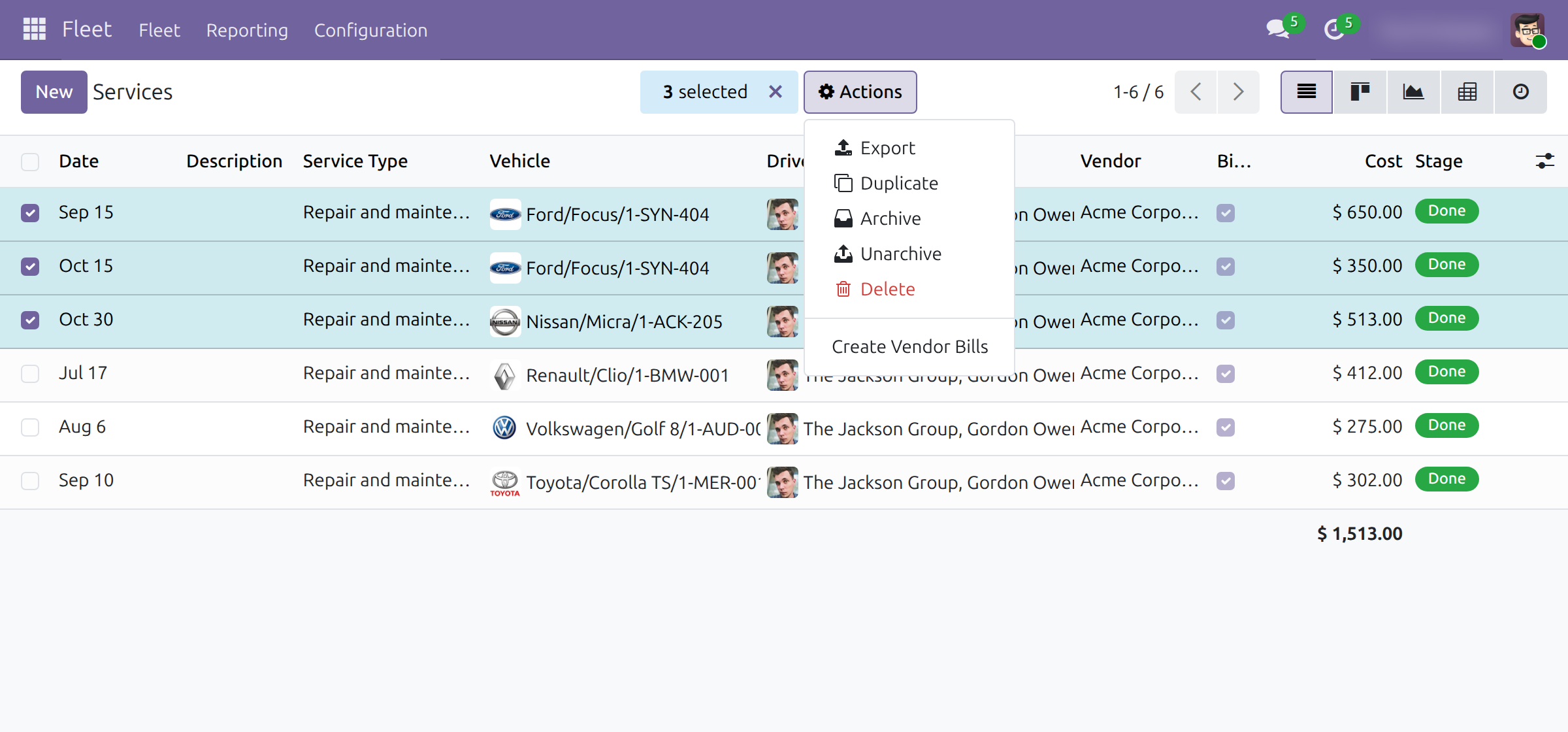
→ The accountant selects the services still to bill and creates them in one action as draft vendor bills or purchase receipts: one per vendor, each line naming the vehicles it is for and charged to them.
A shared cost lands on every vehicle it served
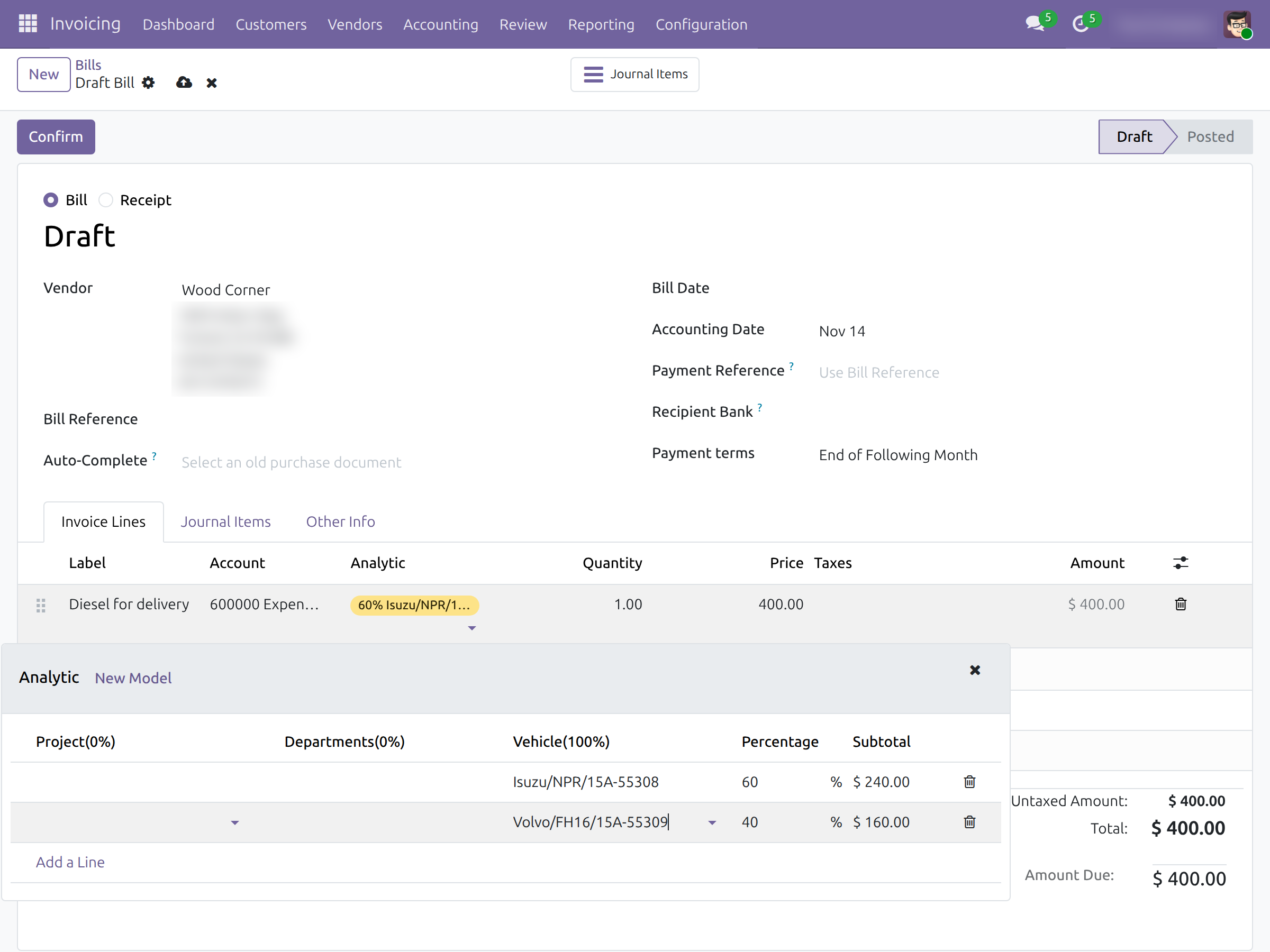
Today one fuel or parts bill for several trucks is split in a spreadsheet, and the fleet log never sees it.
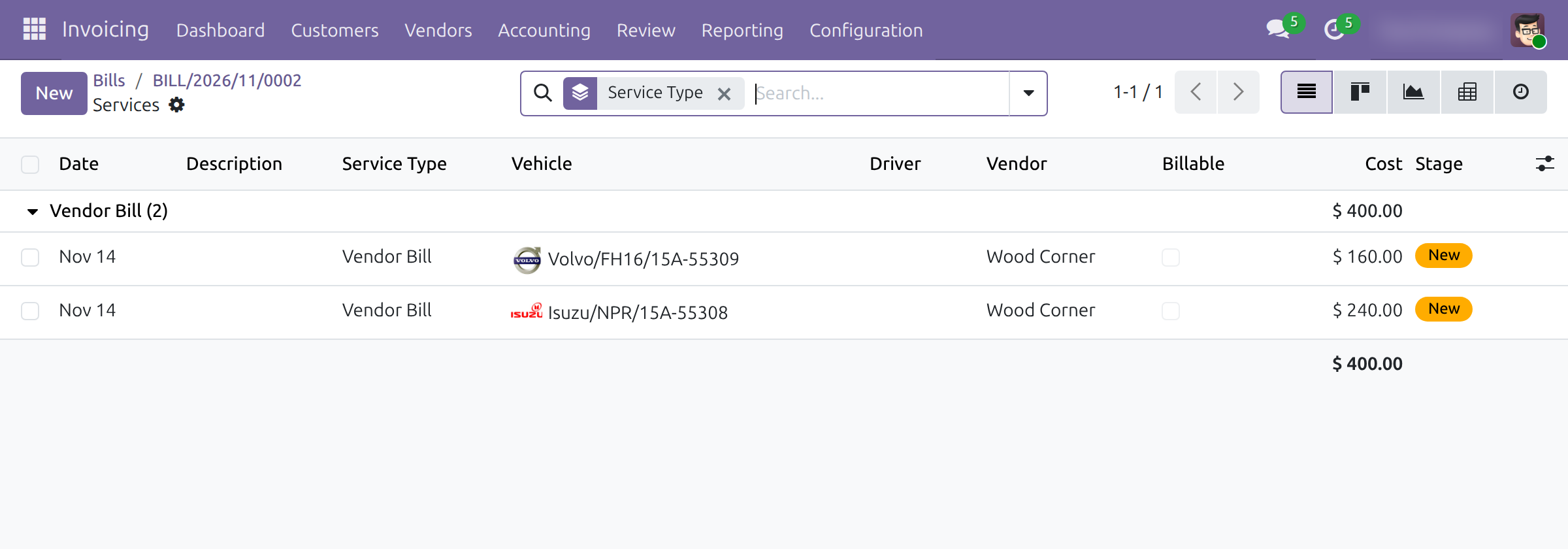
→ The accountant splits the bill line across vehicles by percentage. Confirming the bill logs a service on each vehicle for its share, so the fleet history and the books agree.
Each vehicle shows its own bills and invoices
Today the cost of a vehicle sits in a shared expense account, and its revenue is not tied to it at all.
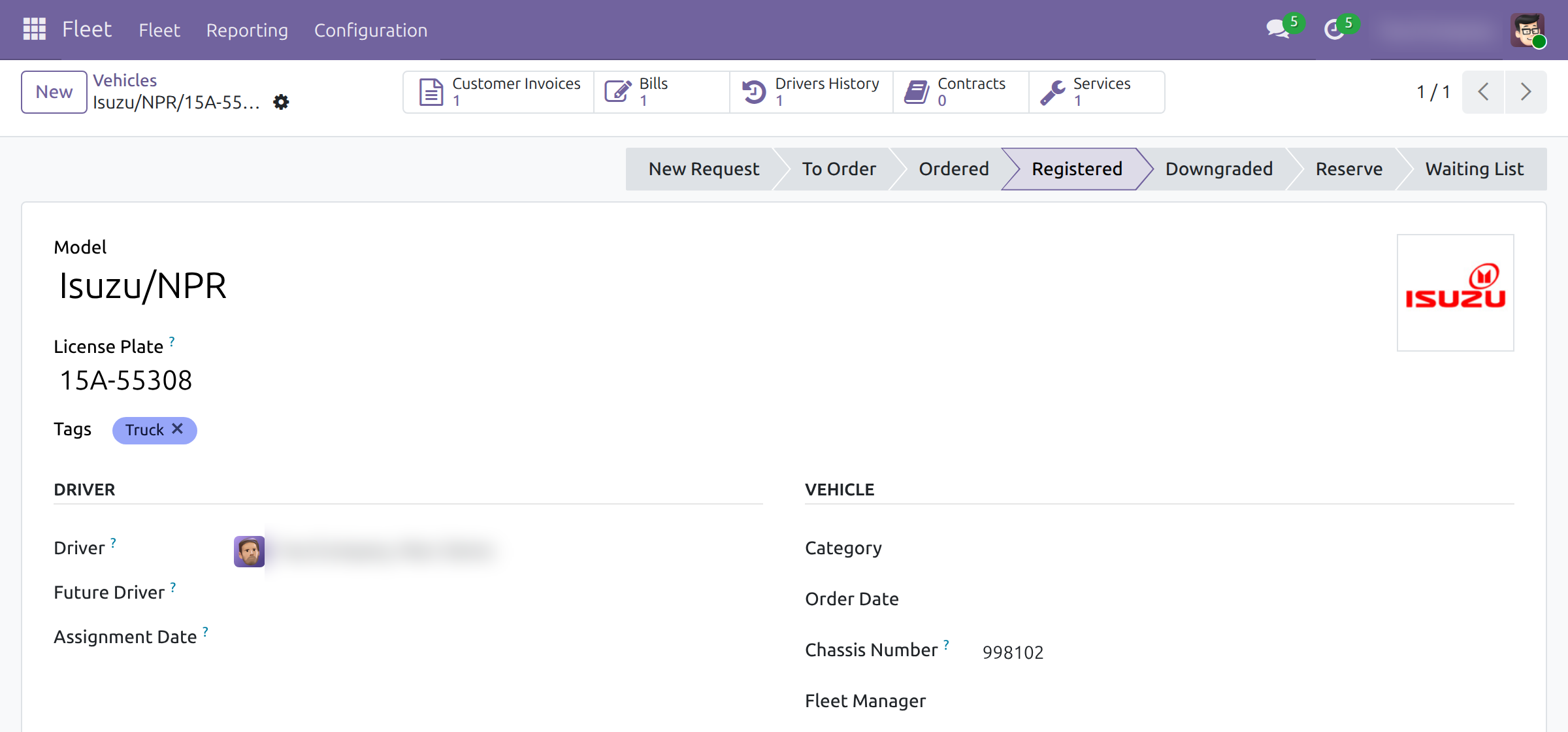
→ Every vehicle has its own analytic account. Its form opens the vendor bills and customer invoices charged to it, and the analytic account shows its cost, revenue and balance.
Ready on day one
A Vehicle analytic plan
Created on install, next to your projects and departments.
An account per vehicle
Existing and new vehicles each get one, renamed whenever the vehicle is.
Billing status on services
Filters show what is still to bill, what is billed and by which vendor.
Check first
The expense account of each service type's Billable Product. Turn on Analytic Accounting to split costs and read revenue per vehicle.
What is included
Vehicle analytic accounts, vendor bills from fleet services, cost split across vehicles, services logged from confirmed bills, revenue per vehicle from customer invoices and protection of billed services. It installs by itself when Fleet and Invoicing are both present.
Optional extensions
Fleet Trip Accounting
Gives each vehicle trip its own analytic account, so costs and revenue can be read trip by trip as well as vehicle by vehicle.
Before you decide
Do I need Analytic Accounting?
For splitting a line across vehicles, revenue per vehicle and the per-vehicle balance, yes. Without it, each vendor bill line carries at most one vehicle and records its cost only.
Can a billed service still be changed?
Its vehicle, service type, product, quantity, unit of measure, unit price, cost, date, vendor and company stay as billed, and it cannot be deleted. To change them, remove its line from the bill and bill it again. Resetting a bill to draft removes the services that bill logged.
Who sees what?
Billing services and recording vehicle costs from vendor bills need the Invoicing access right only; fleet officers record services. The Bills and Customer Invoices buttons of a vehicle count documents for users who also have the accounting features, read-only or more.
Where does the data go?
Into your own analytic accounts, bills and services. The module calls no outside service.
Which languages does it ship?
English and Vietnamese.
Try it, then ask us
The Documentation tab walks the fleet officer, the accountant and the administrator through every screen above; the Live Preview opens a demo database.
Pre-sales & partnership
viindoo.com/contactusTechnical support
viindoo.com/ticketTechnical requirements
- Odoo version: 19.0
- Editions: Community, Enterprise
- Required modules: Accounting/Fleet bridge, Viin Fleet, Accounting Foundation
- License: OPL-1
- Languages: English, Vietnamese
Fleet Cost & Revenue Accounting
This guide is for the people who account for what vehicles cost and earn: the accountant, who bills vehicle services and charges bills and invoices to vehicles, the fleet officer, who records the services, and the administrator, who prepares accounting for it.
Overview
Fleet records what is done to each vehicle; Invoicing records what the company pays and earns. This module connects the two around one idea: every vehicle has its own analytic account. A vendor bill line can be charged to one vehicle or split across several, a customer invoice line can credit the vehicle that earned it, and the services recorded in Fleet can be turned into vendor bills in one step. Each vehicle then shows its bills and customer invoices, and its analytic account shows what it cost and earned.
The work runs in these steps:
- Prepare. The administrator turns on analytic accounting and gives each person their access right. Each vehicle receives its analytic account automatically.
- Record. The fleet officer records each service with its vendor and cost. A service with a vendor that is not billed yet is Billable.
- Bill. The accountant selects the billable services and creates draft vendor bills from them, or enters a vendor bill directly and charges its lines to vehicles, then confirms the bill. Confirming a bill charged to vehicles logs the cost as a service on each vehicle.
- Follow. The accountant charges customer invoices to the vehicles that earned them and follows cost and revenue per vehicle.
| Role | What they do | Access right to assign |
|---|---|---|
| Administrator | Installs the module, turns on analytic accounting, assigns access rights. | Role / Administrator and Accounting / Administrator |
| Fleet officer | Records vehicle services with their vendor and cost. | Fleet / Officer: Manage all vehicles |
| Accountant | Bills services, charges bills and customer invoices to vehicles, follows each vehicle. | Accounting / Invoicing, plus Fleet / Officer: Manage all vehicles to open the services |
Setup (for the Administrator)
Installation
The module installs by itself when Fleet and Invoicing are both installed. You can also open Apps, search for Fleet Cost & Revenue Accounting and click Install.
On installation every existing vehicle receives an analytic account, and each new vehicle receives one when it is created.
Analytic accounting and the accounting features
Billing services and recording vehicle costs from vendor bills need only the Invoicing access right. Two options extend this:
- Analytic accounting lets you split a bill line across several vehicles and record revenue per vehicle. Open Invoicing ‣ Configuration ‣ Settings, tick Analytic Accounting in the Analytics section and click Save. The Analytics section is shown to users who have the full accounting features: give yourself the Show Full Accounting Features right (in the Extra Rights of the user, visible in developer mode), or turn on Accounting & Finance under Advanced Accounting Features on the same settings page.
- The accounting features for the people who follow vehicles. The Bills and Customer Invoices buttons of a vehicle count the documents for users who also have the accounting features, read-only access or more: tick Show Accounting Features - Readonly or Show Full Accounting Features in the Extra Rights of the user.
With analytic accounting on, bill lines are charged to vehicles through the Analytic column. Without it, bill lines carry a Vehicle column instead (add it from the column chooser at the right of the line headers), and each line is charged to at most one vehicle and records only its cost.
Vehicle analytic accounts
The module creates the analytic plan Vehicle. Open Invoicing ‣ Configuration ‣ Analytic Accounting ‣ Analytic Plans, open Vehicle and click Analytic Accounts to see one account per vehicle, with the Debit, Credit and Balance recorded on it.
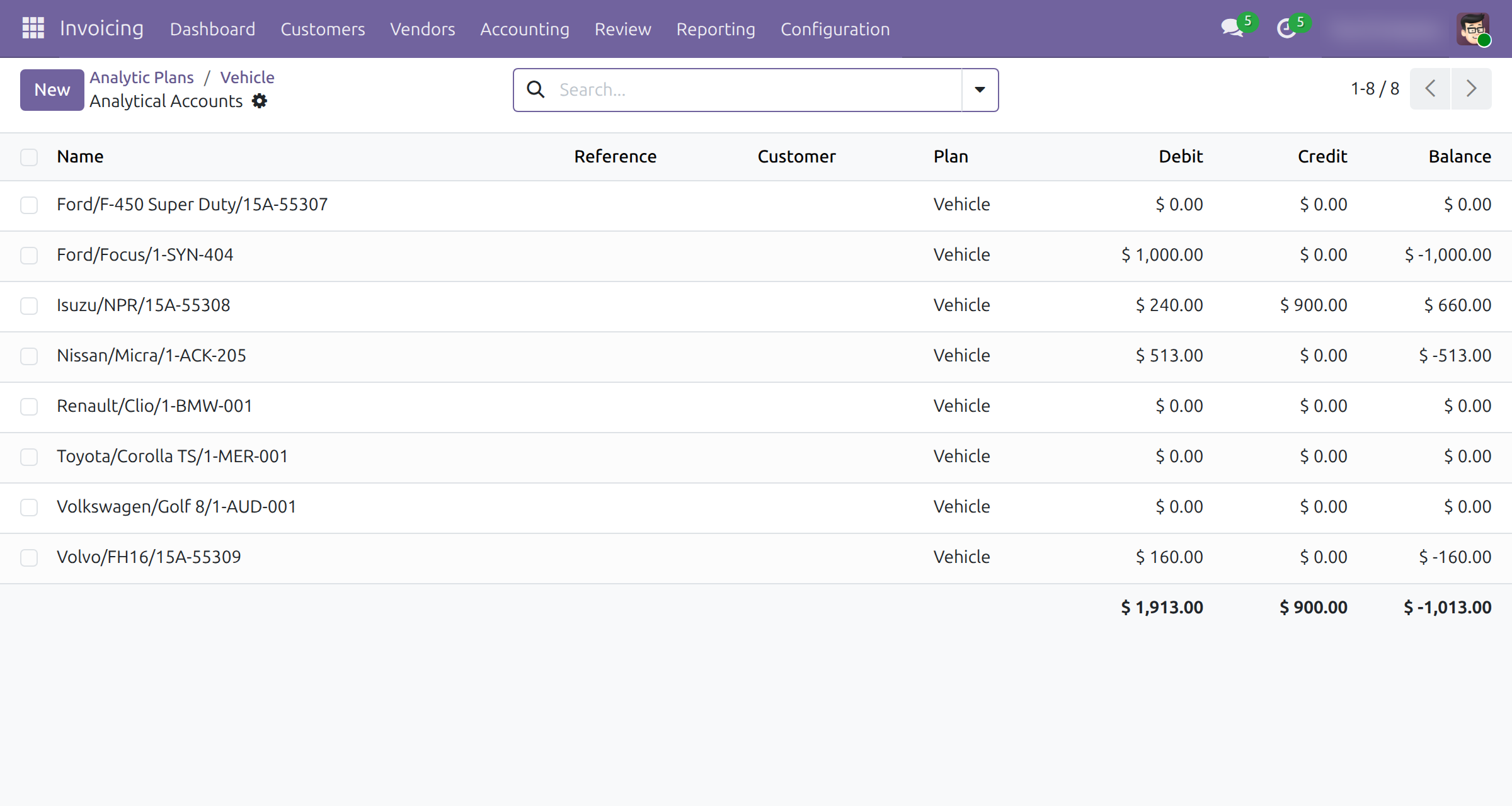
The account takes the name of the vehicle and follows it: changing the model, the brand or the license plate of the vehicle renames the account. For that reason the account itself cannot be renamed (change the model or the license plate of the vehicle instead), cannot be archived while the vehicle is active (archive the vehicle first) and cannot be deleted; the Vehicle plan cannot be deleted either. A vehicle whose account already holds analytic items cannot be deleted; archive it instead.
Service types and their products
A bill created from a service uses the Billable Product of its service type: the product gives the bill line its expense account and vendor taxes. Check the products under Fleet ‣ Configuration ‣ Services ‣ Types; a service type created without a product receives one automatically.
Access rights
Open Settings ‣ Users & Companies ‣ Users, choose a person and open the Access Rights tab:
- Fleet officer: in Human Resources, choose Officer: Manage all vehicles in the Fleet field.
- Accountant: in Accounting, choose Invoicing in the Accounting field. To create bills from services, the accountant also needs the Fleet officer right, which opens the Fleet app. To see the Bills and Customer Invoices buttons of a vehicle, also give the accounting features (see above).
Accounting / Invoicing and Fleet / Administrator include read access to all fleet data. A person who has only Accounting / Invoicing can create and edit the services they recorded or those of the vehicles they drive, and cannot delete services.
Fleet officer: record services to bill
- Open Fleet ‣ Fleet ‣ Services and click New.
- Fill in the Vehicle, the Service Type, the Date and the cost, then the Vendor who did the work.
- Save. A service with a Vendor that has not been billed shows Billable ticked. Add the Billable column to the list from the column chooser to see it on every service.
A service is billed with its own cost: the cost must be greater than zero.
Accountant: bill vehicle services
Create vendor bills from services
- Open Fleet ‣ Fleet ‣ Services and use the To Invoice filter. The Invoiced and Uninvoiced filters and the Vendor grouping help to sort the list.
- Select the services to bill, click Actions and choose Create Vendor Bills.
In the Create Vendor Bills window, choose:
- Invoice Type: Vendor Bill or Purchase Receipt.
- Group By: Vehicle Service Product puts services with the same product, unit of measure and unit price on one bill line; Vehicle Service gives each service its own line.
- Billing Date Option: Manual bills all services of a vendor on one bill dated with the Billing Date (proposed as the latest date of the selected services); Vehicle Service Date makes one bill per vendor and service date.
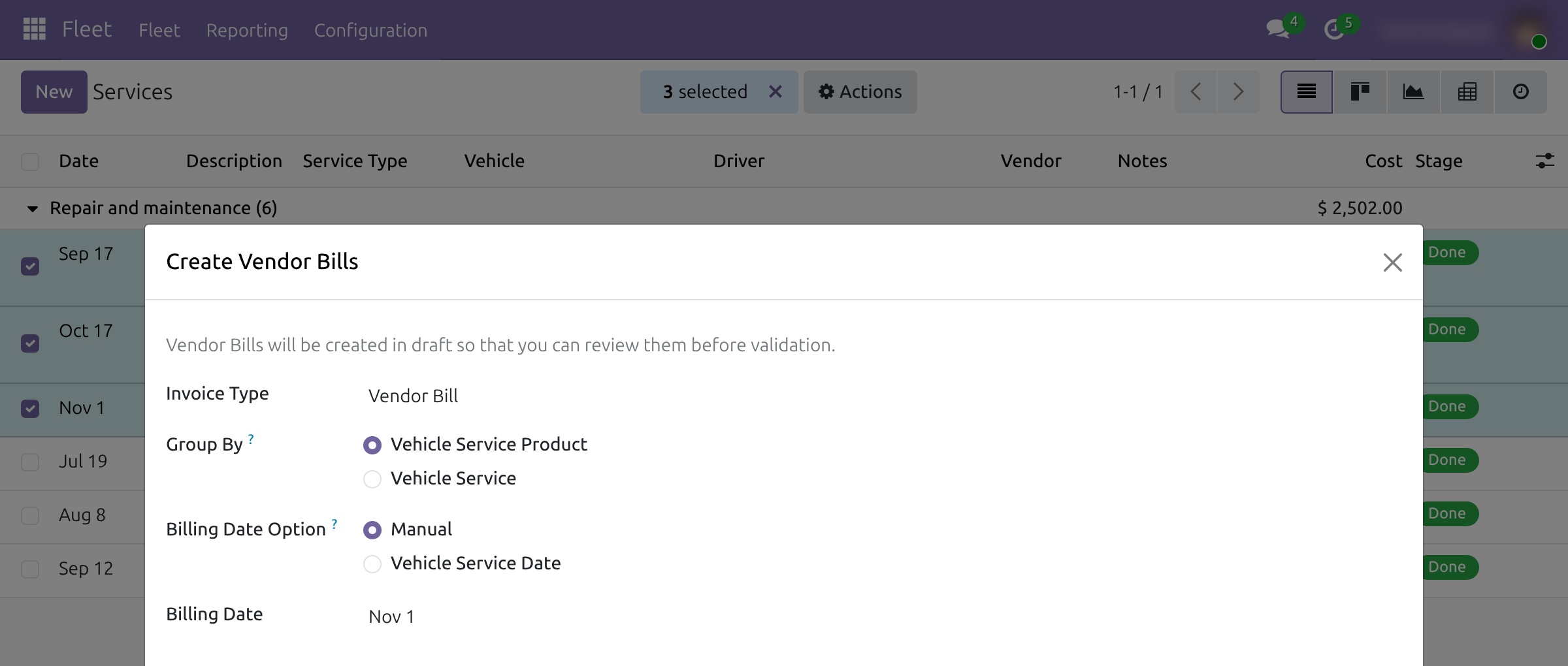
Click Create and View Vendor Bills to open the result, or Create Vendor Bills to stay on the list. With Purchase Receipt, the buttons read Create and View Purchase Receipts and Create Purchase Receipts.
The documents are created in draft, one per vendor, company and currency. When the vendor already has a draft bill in the same currency, the new lines are added to that bill instead. Each line takes the product of the service, its expense account and vendor taxes, a label ending with For and the names of the vehicles, and is charged to the vehicle in the Analytic column. The Fleet Services button of the bill opens the services it bills.
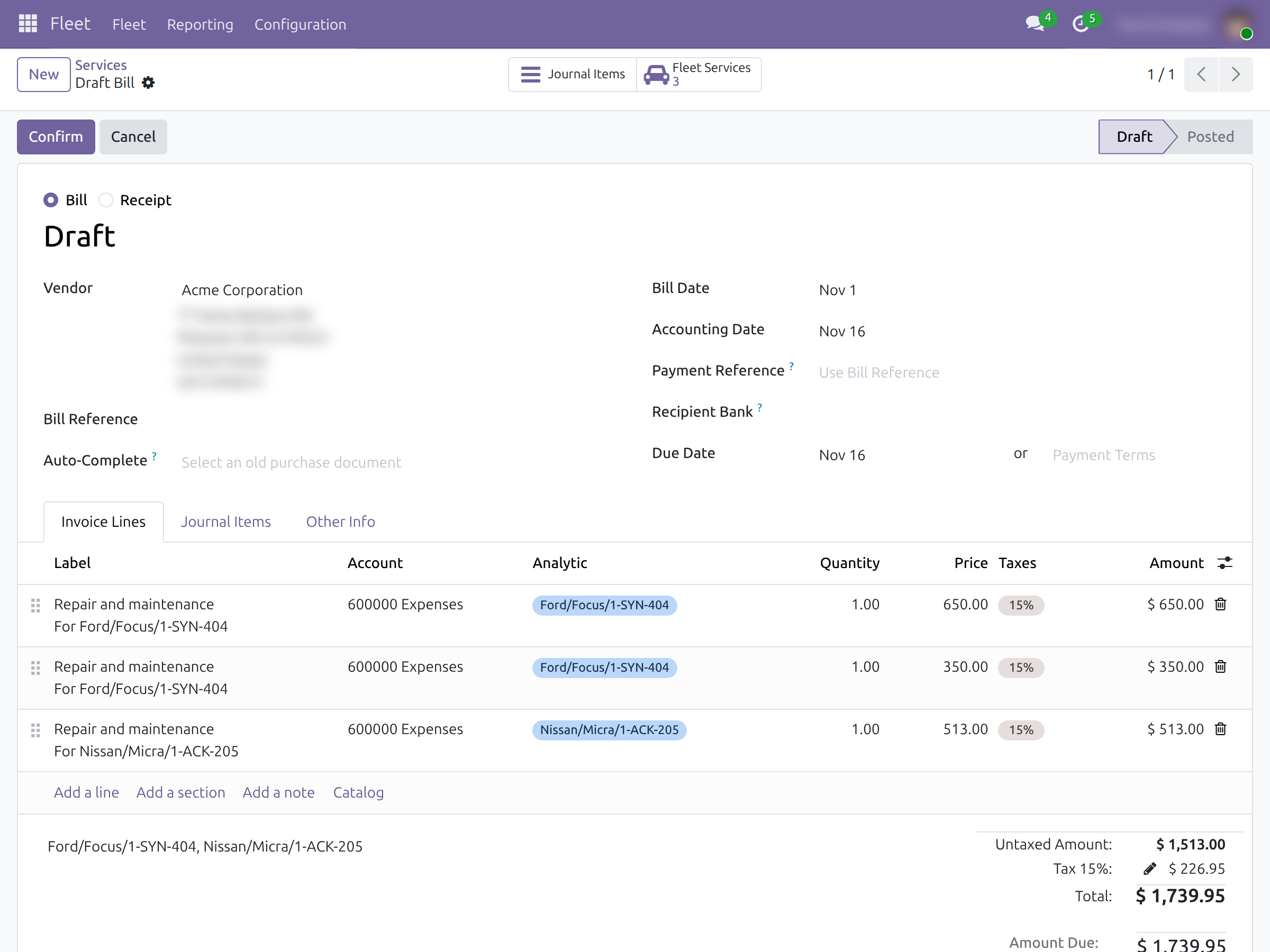
Check the bill, add the vendor's Bill Reference and click Confirm.
What happens to a billed service
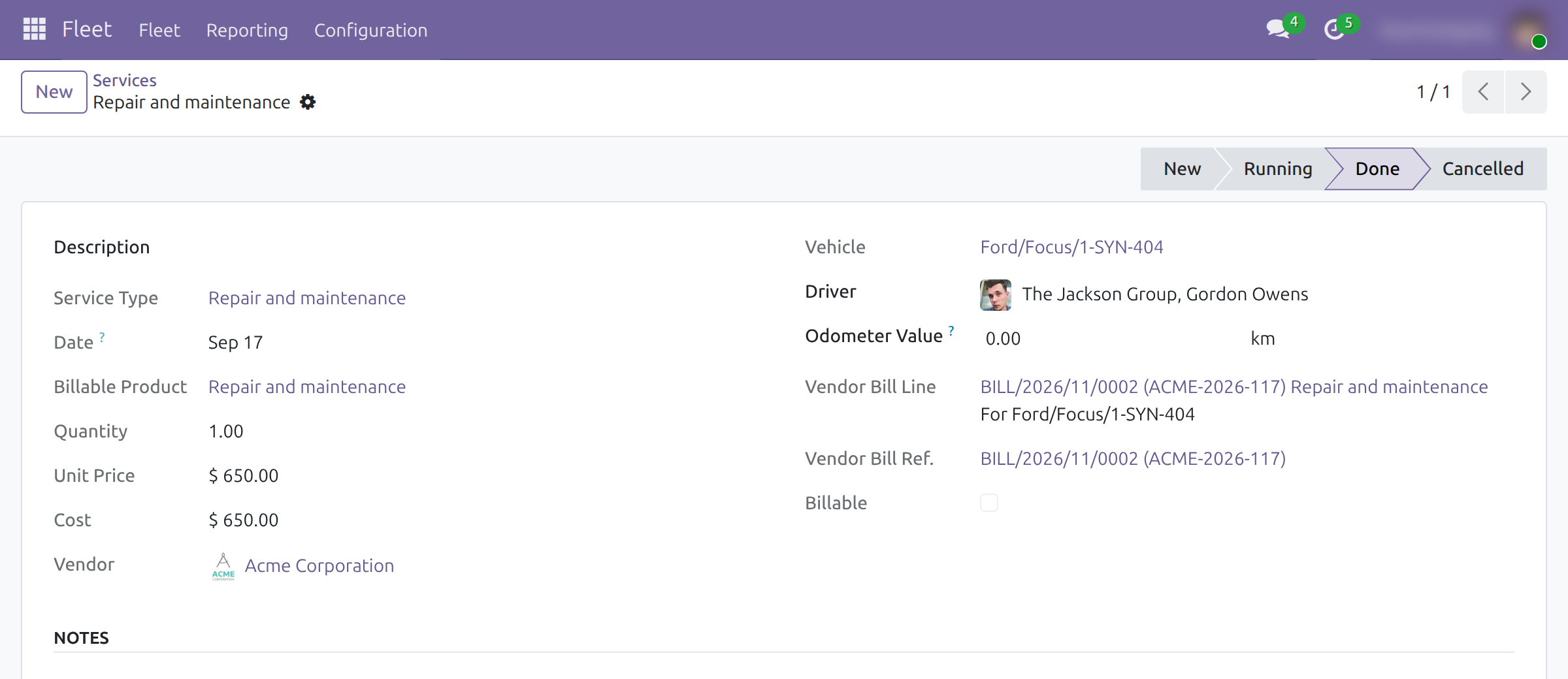
Once billed, a service shows its Vendor Bill Line and Vendor Bill Ref., and Billable is cleared. Its Vehicle, Service Type, Date, Billable Product, Quantity, Unit Price, Cost and Vendor become read-only, and so do its unit of measure and company where the form shows them. A change made another way, from the list or by import, is refused with a message that names the bill and the locked fields. A billed service cannot be deleted.
To change a billed service, take it off its bill (a user with the Invoicing right can do it):
- Open the bill and click Reset to Draft if it is posted.
- Delete the line of the service, or the whole bill, and save the bill.
- Open the service: its fields can be edited again. Make the change and save.
- Bill the service again from the Services list (Actions ‣ Create Vendor Bills). The new line takes the new values; it goes on the vendor's draft bill when there is one.
Accountant: charge bills and invoices to vehicles
Charge a vendor bill to one or several vehicles
Enter the vendor bill as usual under Invoicing ‣ Vendors ‣ Bills. On each line, click the Analytic cell and choose the vehicles in the Vehicle column of the distribution, with the Percentage of each. A fuel bill for two trucks, for example, can go 60% to one and 40% to the other.
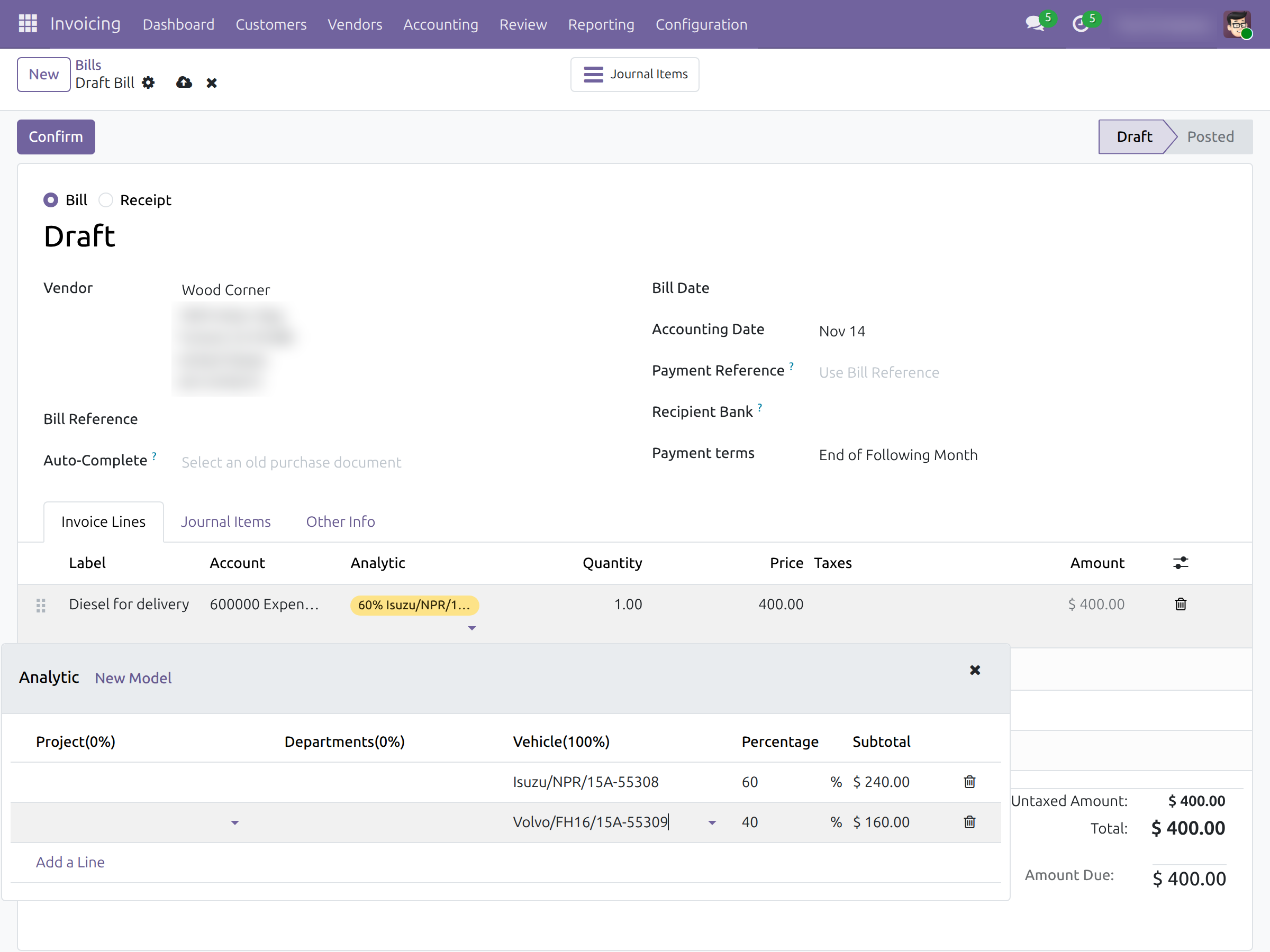
When you click Confirm, each vehicle charged on the bill receives a service for its share of the cost, dated on the bill and with the bill's vendor. The service type is the one whose product is on the line, or Vendor Bill when the line has none. The Fleet Services button of the bill lists these services.
These services belong to the bill and follow it: their vehicle, cost, date, vendor and the other fields listed under What happens to a billed service cannot be changed on the service, and they cannot be deleted on their own. To correct them, correct the bill: click Reset to Draft (the services are removed), change the line and confirm the bill again (the services are created again). Purchase receipts work the same way.
Without analytic accounting, choose the vehicle in the Vehicle column of the line; confirming the bill logs one service for that vehicle.
Record revenue per vehicle
On a customer invoice (Invoicing ‣ Customers ‣ Invoices), charge the line to the vehicle that earned it in the Vehicle column of its Analytic distribution, then confirm the invoice. The revenue is credited to the vehicle's analytic account.
Follow cost and revenue per vehicle
Open the vehicle (Fleet ‣ Fleet ‣ Fleet). The Bills button opens the vendor bills and purchase receipts charged to it, the Customer Invoices button the customer invoices; cancelled documents are not counted. The buttons appear once the vehicle has such a document.
For figures, open the vehicle accounts of the Vehicle plan (see Vehicle analytic accounts above): Debit is what the vehicle cost, Credit what it earned and Balance the difference. Invoicing ‣ Reporting ‣ Management ‣ Analytic Report analyses the same amounts further.
This software and associated files (the "Software") may only be used (executed, modified, executed after modifications) if you have purchased a valid license from the authors, typically via Odoo Apps, or if you have received a written agreement from the authors of the Software (see the COPYRIGHT file).
You may develop Odoo modules that use the Software as a library (typically by depending on it, importing it and using its resources), but without copying any source code or material from the Software. You may distribute those modules under the license of your choice, provided that this license is compatible with the terms of the Odoo Proprietary License (For example: LGPL, MIT, or proprietary licenses similar to this one).
It is forbidden to publish, distribute, sublicense, or sell copies of the Software or modified copies of the Software.
The above copyright notice and this permission notice must be included in all copies or substantial portions of the Software.
THE SOFTWARE IS PROVIDED "AS IS", WITHOUT WARRANTY OF ANY KIND, EXPRESS OR IMPLIED, INCLUDING BUT NOT LIMITED TO THE WARRANTIES OF MERCHANTABILITY, FITNESS FOR A PARTICULAR PURPOSE AND NONINFRINGEMENT. IN NO EVENT SHALL THE AUTHORS OR COPYRIGHT HOLDERS BE LIABLE FOR ANY CLAIM, DAMAGES OR OTHER LIABILITY, WHETHER IN AN ACTION OF CONTRACT, TORT OR OTHERWISE, ARISING FROM, OUT OF OR IN CONNECTION WITH THE SOFTWARE OR THE USE OR OTHER DEALINGS IN THE SOFTWARE.